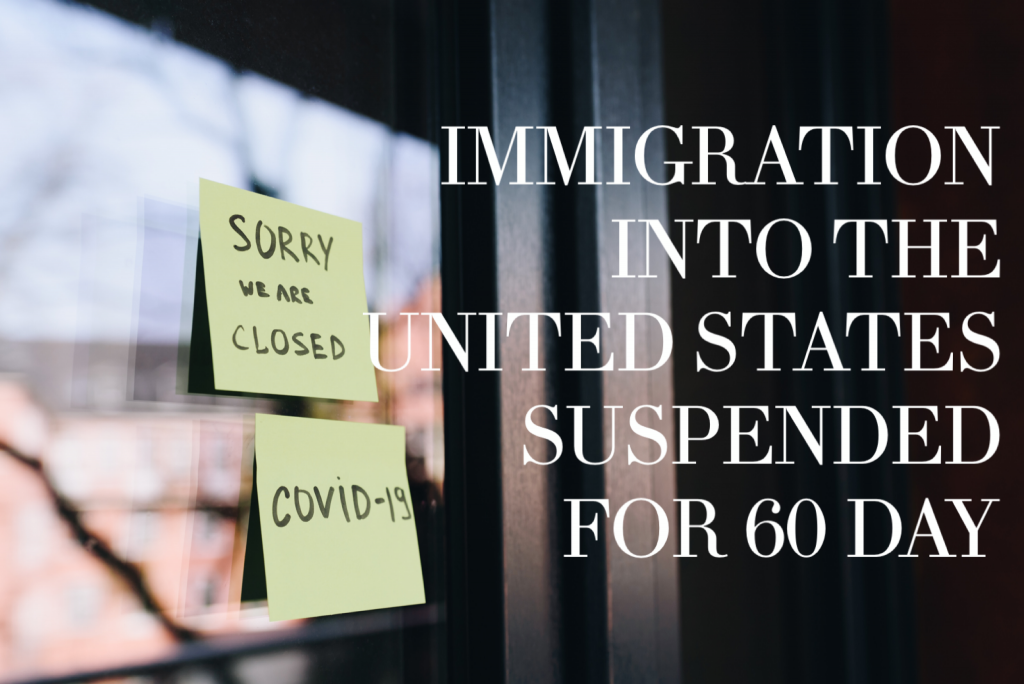
After an announcement on twitter on April 20, 2020, President Trump signed an Executive Order, aimed to suspend and limit immigration into the United States on a temporary bases, during the COVID-19 outbreak to protect U.S. citizens and preserve jobs for American workers.
The temporary suspension will take effect on April 23, 2020. According to the Executive Order, a 60-day suspension is placed on the entry of new immigrants (permanent residents) into the United States from abroad. As it turns out, the restriction is not as widespread as it was originally expected, however, the 60-day period may be extended, and additional restrictions may follow.
The current order applies to foreign national if they are: outside the U.S. on April 23, 2020; do not have an immigrant visa that is valid on April 23, 2020; and do not have an official travel document other than a visa (such as a transportation letter, an appropriate boarding foil, or an advance parole document).
Practically, this suspension will work as a limitation on immigrant visa issuance and as a restriction on entry into the United States. It will mean that U.S. Consulates and Embassies abroad will no longer issue immigrant visas to those foreign nationals who fall within the above described categories and on the other hand it will also mean that U.S. Port of Entry officials will not grant entry into the U.S. to those who do not fall within an exception category mentioned below.
The suspension and limitation on entry does not apply to the following categories:
a) Current lawful permanent residents of the United States
b) Any foreign nationals seeking to enter on an immigrant visa to work as a physician, nurse, or other healthcare professional to perform medical research or other research intended to combat the spread of COVID-19; or to perform work essential to combating, recovering from, or otherwise alleviating the effects of the COVID-19 outbreak (and their spouses/children)
c) Any foreign national seeking to enter the United States as the spouse of a U.S. citizen or as a child (under age 21) of a U.S. citizen
d) EB-5 investors;
e) Spouses of U.S. Citizens;
f) Foreign nationals who are under 21 years old and are children of U.S. citizens;
g) Foreign nationals whose entry furthers U.S. law enforcement objectives;
h) Asylum seekers and certain Special Immigrant entrants such as Iraqi and Afghani nationals who have assisted the U.S. military: and
i) Any other foreign national whose entry would be in the national interest, as determined by the Secretary of State or the Secretary of Homeland Security
Most importantly, the suspension of immigrant visa processing does not currently apply to anyone who is in the United States on April 23, 2020 and it does not affect several other areas of immigration processing:
1. The processing of petitions for foreign nationals in the United States or abroad, such as Form I-130, Petition for Alien Relative and/or Form I-140, Petition for Alien Worker;
2. The processing of green cards in the United States for any foreign national in the U.S. who is eligible to apply for adjustment of status through Form I-485; and
3. Foreign nationals who are outside the U.S. and seeking to enter on a nonimmigrant visa, classes of which include H, L, B, E, F, J, TN, O, P, or R visas
We will be monitoring these developments closely and will provide updates as soon as they become available.
This alert does not purport to be a substitute for advice of counsel on specific matters. Should you have any questions or concerns, please feel free to contact us, we are here to assist!